Towards the end of every year, people people seem eager to transform or reflect on ways they could improve — all of which is good.
Despite this, I am still curious of the outcome, as most people I meet do not seem to maintain the momentum they gain with their resolutions in the beginning of the year.
There really has only been 1 study tracking the pursuit of New Year’s Resolutions over the course of at least 1-year. This is a 1988 study (38 years old when writing this), by Norcross and Vangarelli. They found that New Years resolutions were actually quite successful:
In a sample of 216 participants:
About 77% of participants reported success at 1 week
55% at 1 month
40% at 6 months
Longer term goals were not tracked
The key predictors of success were readiness to change and confidence/self-efficacy, with the following strategies being useful:
- Stimulus control <– changing environments
- Self-liberation <– commitment strategies
- Reinforcement management <– reinforcement management
Unsuccessful individuals turned to:
- Self-blame
- Wishful thinking
- Avoidance
(Norcross et al, 1989)
This needs to be taken with a grain of salt though, their goals were concrete, “yes” or “no” goals without intervention or coaching.
So yes, those New Years Goals are achievable, as long as we quantify them and have them become second nature habits.
The world is also a very different place than 38 years ago. Factors such as technology potentially making more difficult or simple to achieve.
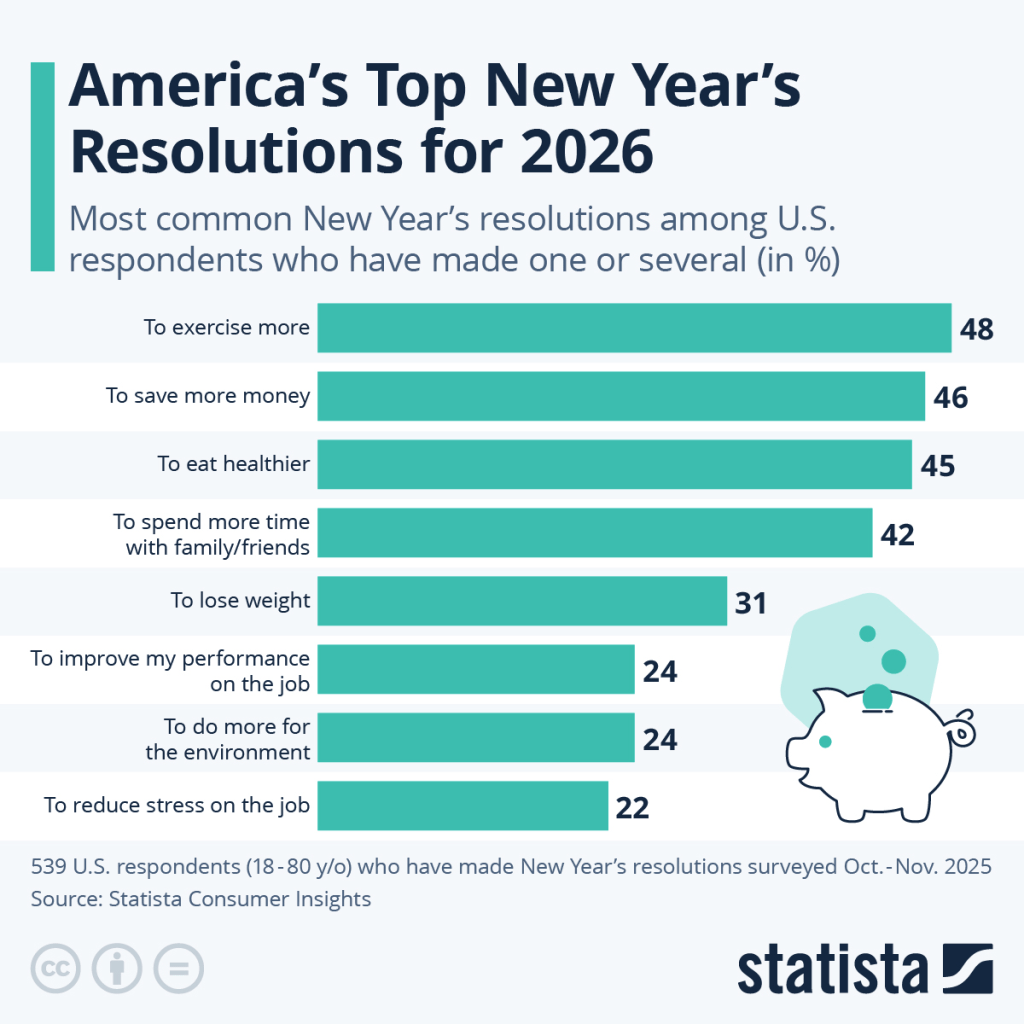
(Fleck, 2025)
Works Cited:
Norcross, J. C., Ratzin, A. C., & Payne, D. (1989). Ringing in the new year: The change processes and reported outcomes of resolutions. Addictive Behaviors, 14(2), 205–212. https://doi.org/10.1016/0306-4603(89)90042-8
Anna Fleck, Statista. (2025, December 16). America’s top New Year’s resolutions for 2026 [Chart]. Statista. https://www.statista.com/chart/29019/most-common-new-years-resolutions-us/
 TheWhyLab