In last week’s entry, we found that brain cells can in fact perform computational operations. The brain is 1,000 to 10,000 times more energy efficient per watt than silicon based computation (our computers and phones). The question remains, how does this work? And in finding how this works,
I used the 2023 Kagan et Al. paper (funded by Cortical Labs btw) titled “In vitro neurons learn and exhibit sentience when embodied in a simulated game-world”. Their major finding was that:
Applying implications from the theory of active inference via the free energy principle, we find apparent learning within five minutes of real-time gameplay not observed in control conditions.
They essentially found that the neurons within the chip could learn to play the game of pong within 5 minutes:
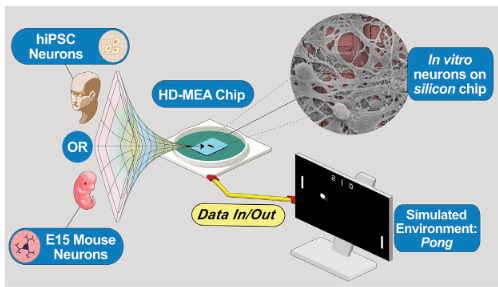
Figure A – Diagrammatic overview of DishBrain setup. (Kagan et. Al, 2023).
If not familiar:
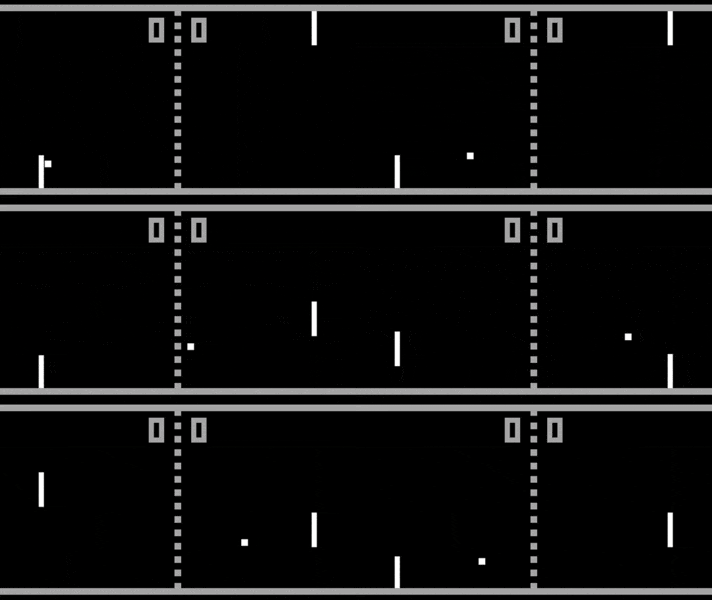
Despite seeming impressive, I had to read between the lines, they mentioned “Active Inference” in their findings. Active Inference is:
a mathematical framework stating that all adaptive, self-organizing systems—from cells to brains—act to minimize “surprise” (or variational free energy) to maintain their structural integrity
My basic interpretation: physical systems, want to (by some force or another) minimize surprise. Here is a schema (Wikipedia):
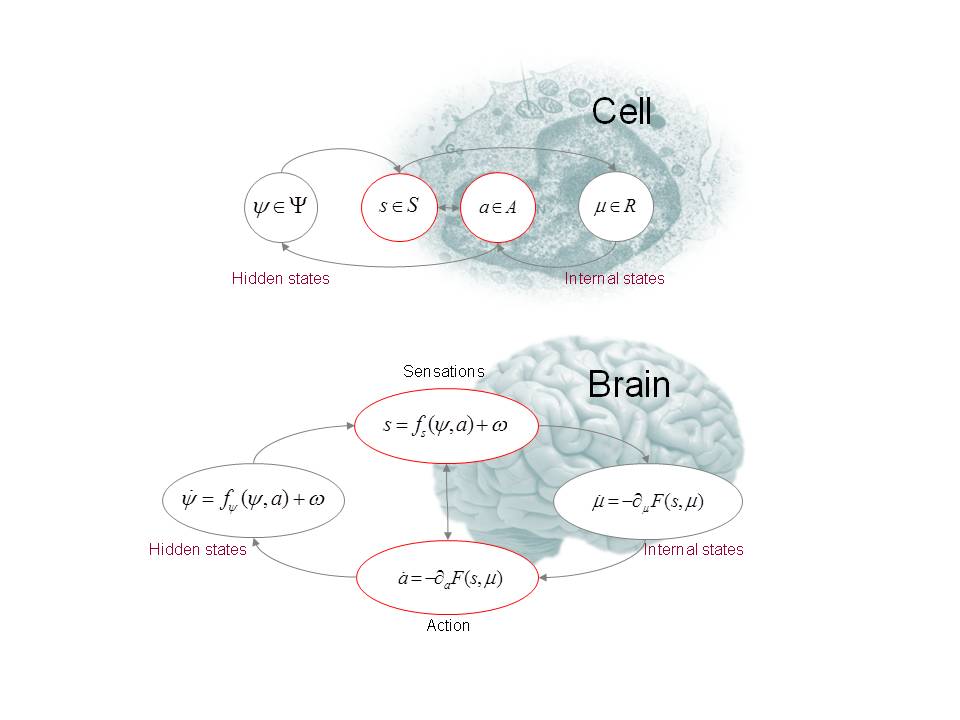
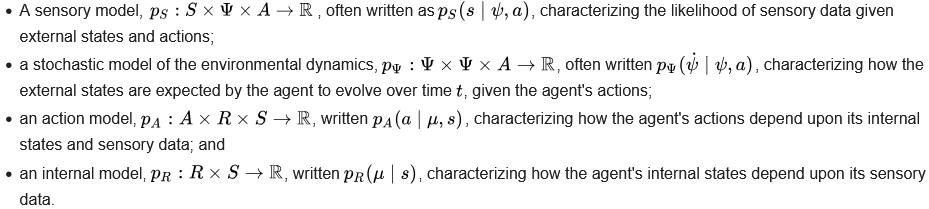
Figure 2 – By Kfriston – Own work, CC BY-SA 3.0, https:/ commons.wikimedia.org/w/index.php?curid=26201518
To spare you the boredom and tedious process of understanding complex, mathematical notation:
Systems with feedback loops can encode a history in their structures, therefore influencing how they behave in the future
Now, what other systems hold this property?
- Whirlpools:

Once you turn off the hot tub, it keeps spinning.
- Ooblek (mixture of cornstarch and water — if you remember your middle school science class):
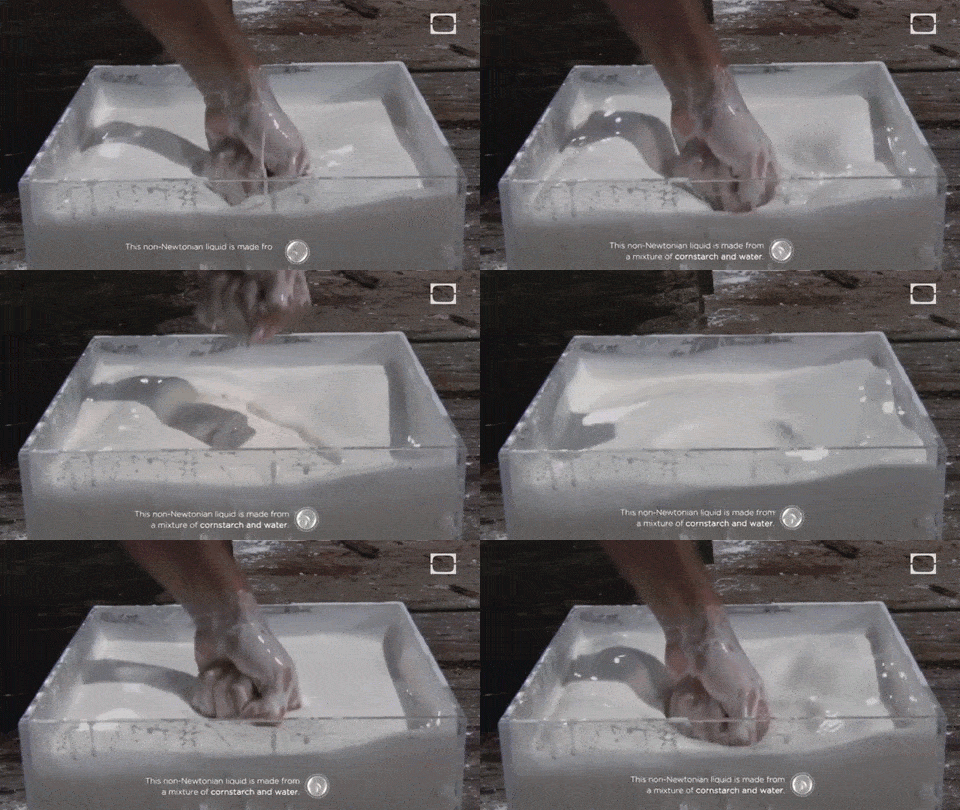
The substance retains some of its shape after impact.
- Ferrofluid: liquid magnet.
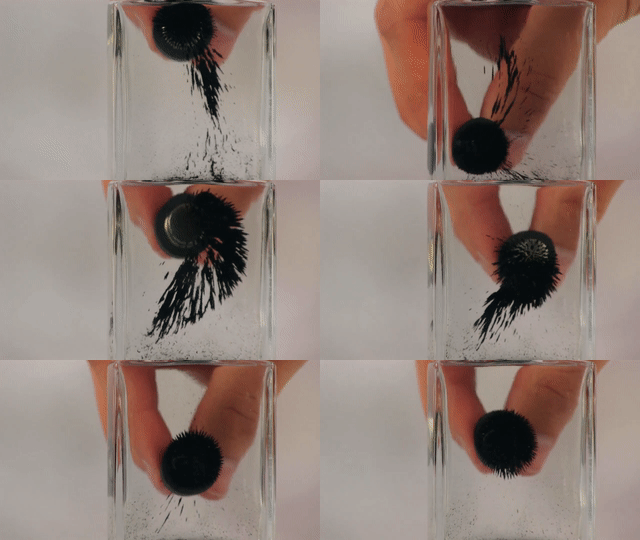
The ferrofluid “remembers” its past paths.
So could these substances be used for “computation” the same way that neurons have in the paper —> YES
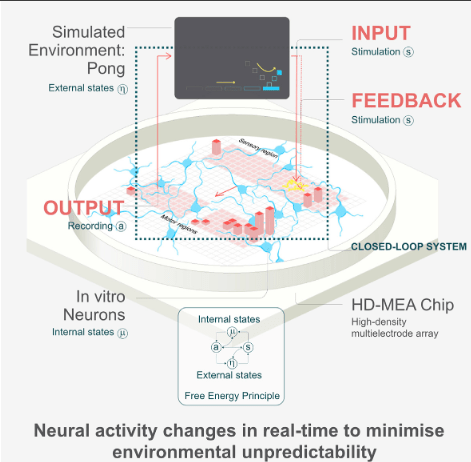
Figure 3 – Kagan et Al. 2023
The neurons DID rearrange themselves into a predictable pattern, as could any of the other materials.
Despite this, neurons hold their shape, as the other materials would not once the game input is over. However, I highly doubt that neurons could survive, be as concentrated, as microscopic as actual computer chip transistors.
Neurons do have the ability to arrange themselves on their own and form networks spontaneously, which is worth considering..
Sources:
Kagan B, Kitchen A, Tran N …In vitro neurons learn and exhibit sentience when embodied in a simulated game-world Neuron, 2022; 110, 3952-3969.e8 -> https://www.cell.com/neuron/fulltext/S0896-6273(22)00806-6?_returnURL=https%3A%2F%2Flinkinghub.elsevier.com%2Fretrieve%2Fpii%2FS0896627322008066%3Fshowall%3Dtrue
 TheWhyLab