I recently received a Fulbright Research grant to study aging, this entry dives deeper into the potential and impact of this project.
This project develops a German-language AI assistant designed to help older adults manage everyday tasks while preserving autonomy and dignity. Based at Charité in Berlin, it combines large language models with real-world testing to evaluate how AI can support independent aging in practice.
What if outsourcing higher-level Cognitive Processes could help people with Cognitive Impairment maintain independence and possibly improve in their condition?
As AI becomes more powerful, a key question remains: who actually benefits from it? Humans will eventually converge with machine, Neuralink (linked, covered in a previous entry) provides an extreme, cyborg, sci-fi-like reality. Despite this, we’ve yet to understand how humans interact and could benefit from intelligent machines taking on complex cognitive processes.
AI has made up $20.7 trillion in market-cap (companies market cap database), it is debated whether this have translated to real-life value. The lifetime risk of dementia after age 55 years is 42% in the US alone (Fang et Al. 2025). Application of AI tools that have great thinking ability, could potentially serve as an adaptive support system or supplement for individuals older adults at risk of dementia.
I explore this concept in my upcoming Fulbright Research Project at Charité – Universitätsmedizin Berlin, where I will develop and design a framework where humans can directly benefit from AI:
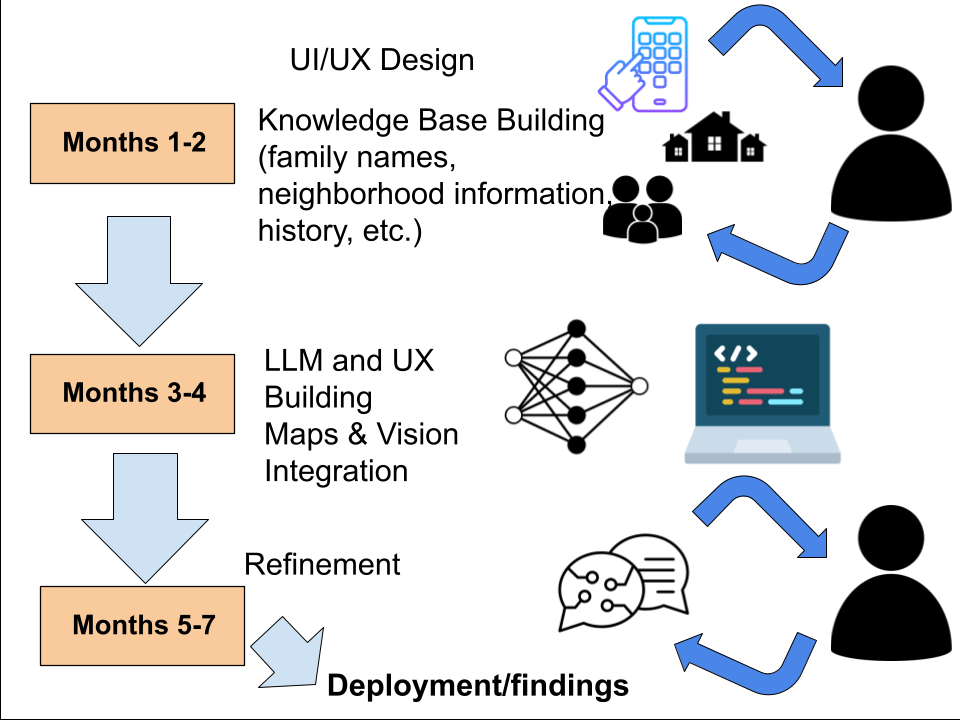
Figure 1 – Development Chart
The system may help a user interpret an official letter, plan a trip across the city, or turn a recipe into a structured shopping list. Whether this kind of support can truly improve quality of life, slow cognitive decline, or reduce anxiety remains a major wall for many individuals and families. This project aims to examine that wall directly, and if possible, begin to break it.
Human-Machine interaction is the key to fully unlocking the potential of thinking machines. Understanding the effects and perfecting design will shape and push the limits of integrating with this technology in addition to understanding what AI really does and means for humanity.
AI simplifies intelligence, which in its essence is prediction with some pattern recognition, which is a new way for humans to develop knowledge and understand the world around us.
This project is part of my Fulbright research; views are my own.
Sources:
https://companiesmarketcap.com/artificial-intelligence/largest-ai-companies-by-marketcap/
Fang M, Hu J, Weiss J, Knopman DS, Albert M, Windham BG, Walker KA, Sharrett AR, Gottesman RF, Lutsey PL, Mosley T, Selvin E, Coresh J. Lifetime risk and projected burden of dementia. Nat Med. 2025 Mar;31(3):772-776. doi: 10.1038/s41591-024-03340-9. Epub 2025 Jan 13. PMID: 39806070; PMCID: PMC12305800.
 TheWhyLab